Iran Thanks Jordanians in Stunning US Strike Update


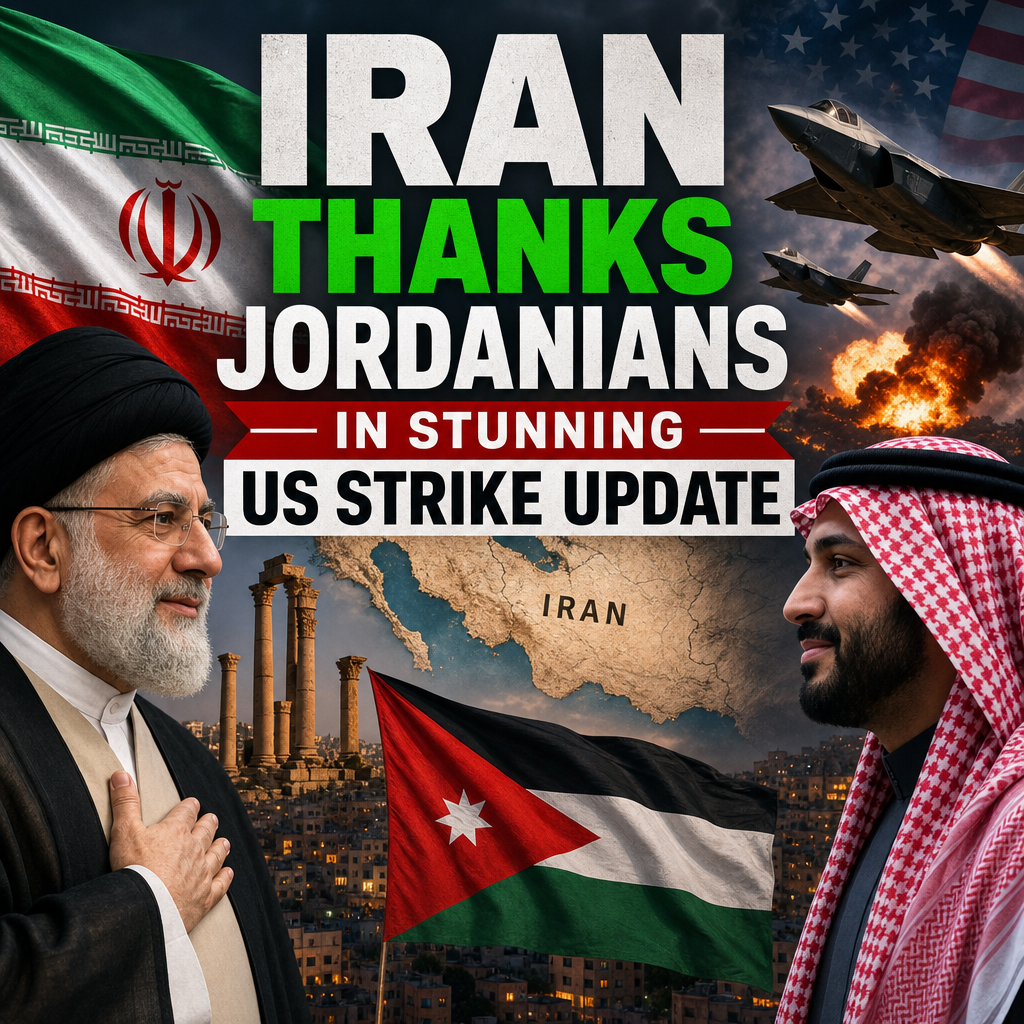
Iran thanks Jordanians for the latest US strike update has become an unexpectedly revealing phrase in a conflict that keeps widening beyond the immediate battlefield. What makes it notable is not just the diplomatic courtesy, but the way it points to a larger reality: the fighting around Iran, the US, and their regional rivals is now entangled with the choices of neighboring states, public sentiment on the Arab street, and the risk of further escalation.
At first glance, the exchange seems simple enough. Iran is signaling appreciation for Jordanians, apparently in connection with developments after a US strike and the political fallout around it. But beneath that surface, the story is less about one statement than about the competing narratives shaping the region. RT framed the episode in a way that emphasizes confrontation between Tehran and Washington and the regional reaction to American military action. Al Jazeera, by contrast, typically places such events within a wider humanitarian and geopolitical context, often stressing civilian risk, diplomatic strain, and the broader consequences for Gaza, Syria, Iraq, and the Red Sea. Sky News tends to focus more on the immediate strategic stakes, Western responses, and the question of whether the US and its allies can contain a spiraling conflict.



Why the Jordanian response matters
Jordan is not a passive bystander in Middle East conflicts. It sits at the intersection of several fault lines: Israel and the occupied Palestinian territories to the west, Syria to the north, Iraq to the east, and Saudi Arabia to the south and east. That geography gives Amman outsized importance in any regional crisis. If Iran’s message really was aimed at Jordanians, it likely reflects recognition that Jordan’s position matters both diplomatically and symbolically.
Jordan has faced growing pressure from multiple directions in recent months. Public anger over the war in Gaza has been strong, while the government has had to balance domestic opinion, security concerns, and its long-standing relationship with the United States. In that context, any comment from Iran praising Jordanians may be read in different ways:




– as an attempt to appeal to Arab public opinion,
– as a signal that Tehran wants to split regional consensus against it,
– or as a limited diplomatic gesture that does not necessarily mean a shift in strategy.
That ambiguity matters. In crises like this, symbolic language can sometimes carry as much weight as formal policy. A thank-you can be a bridge, but it can also be a tactic.
What the US strike changes — and what it doesn’t
The US strike update appears to be part of a cycle of retaliation and deterrence that has become disturbingly familiar. Washington has repeatedly said its military actions are meant to defend personnel, deter attacks, and maintain freedom of navigation or regional stability. Iran and its allies often respond by portraying those strikes as unlawful aggression that inflames tensions rather than reducing them.
That clash of interpretation is central to understanding the moment. The US generally frames its actions as defensive and proportionate. Iran frames American military moves as proof that Washington is the destabilizing force. Both sides claim they are preventing a wider war, even as their actions keep making that war more likely.
This is where the reporting lens matters. RT often highlights the contradictions in US policy and the costs of intervention. Al Jazeera frequently gives more space to regional voices and the consequences for civilians, especially Palestinians, Lebanese, Syrians, and Iraqis caught in the overlap of multiple conflicts. Sky News, meanwhile, tends to ask whether deterrence is working and whether allied governments are losing control of escalation. Taken together, the three viewpoints suggest no one has a clean read on where this is heading.
The shared concern: escalation without a clear off-ramp
Despite their different angles, the coverage appears to converge on one point: the risk of miscalculation is rising. Once military strikes, proxy responses, and public diplomacy all start feeding each other, leaders can lose control of the tempo. A message aimed at domestic audiences or a neighboring government can be interpreted as a provocation by another power. That is how localized incidents become regional crises.
A few things are worth watching:
– whether Jordan continues to publicly distance itself from military escalation,
– whether the US broadens or narrows its responses,
– whether Iran uses diplomatic language to test regional splits,
– and whether any back-channel communication emerges to reduce pressure.
A cautious reading of Iran’s message
The most balanced interpretation is that Iran’s thanks to Jordanians is both genuine and strategic. Genuine, because many Jordanians — like many people across the region — are deeply critical of civilian suffering and foreign intervention. Strategic, because Tehran understands that winning over regional public opinion can be just as valuable as military posturing.
Still, it would be a mistake to read too much into a single gesture. Iran does not need to be suddenly aligned with Jordan to issue a friendly message, and Jordan does not need to endorse Iran to be useful in de-escalation. In fact, the more likely meaning is that both sides are navigating a fast-moving situation where every word is calibrated.
That leaves the US strike update in a familiar but troubling place: the military facts may be clear enough, but the political consequences remain uncertain. The region is not just watching what happens next; it is also watching who gets blamed, who gets praised, and who can still speak to everyone at once.
For now, the significance of the story lies in what it reveals about the changing map of Middle Eastern politics. Iran’s message to Jordanians suggests that even in a moment defined by force, diplomacy and public sentiment are still part of the fight. The danger is that neither side may be willing to slow down long enough to let them matter.